
Evaluate and Compare Natural Supplements
With so many options available in the Indonesian market, choosing the right supplement can be overwhelming. Our comparison matrix is designed to help you analyze different products based on their ingredient profiles, concentrations, and delivery formats. We provide the data you need to distinguish between a basic multivitamin and a high-potency herbal complex.

Raw ingredients tell you more than marketing copy. Learn to read what is actually in the bottle.
Magnesium citrate is generally better absorbed than magnesium oxide.
The form of a mineral matters as much as the dose.
Capsule vs. Powder vs. Liquid — which delivery format fits your Jakarta routine?
Read the comparisonUnderstanding Ingredient Labels
The first step in comparing supplements is learning how to read the label. A proprietary blend lists several ingredients under one total weight, without showing how much of each you actually get. That makes it hard to tell whether a formula contains a meaningful amount of an active compound or just a trace dusting for the label.
We break down the difference between proprietary blends and transparent ingredient lists. A transparent label shows the exact milligram amount of every active ingredient. Our guide shows you how to identify the actual amount of active vitamins and minerals, ensuring you get the value and results you expect.
Look for the serving size first, then scan the active ingredient column. Compare the listed amount against published daily values. If a label only says a blend weighs 800 mg but does not break it down, you cannot evaluate whether that blend delivers enough of any single compound to matter for your routine.
Capsule vs. Powder vs. Liquid
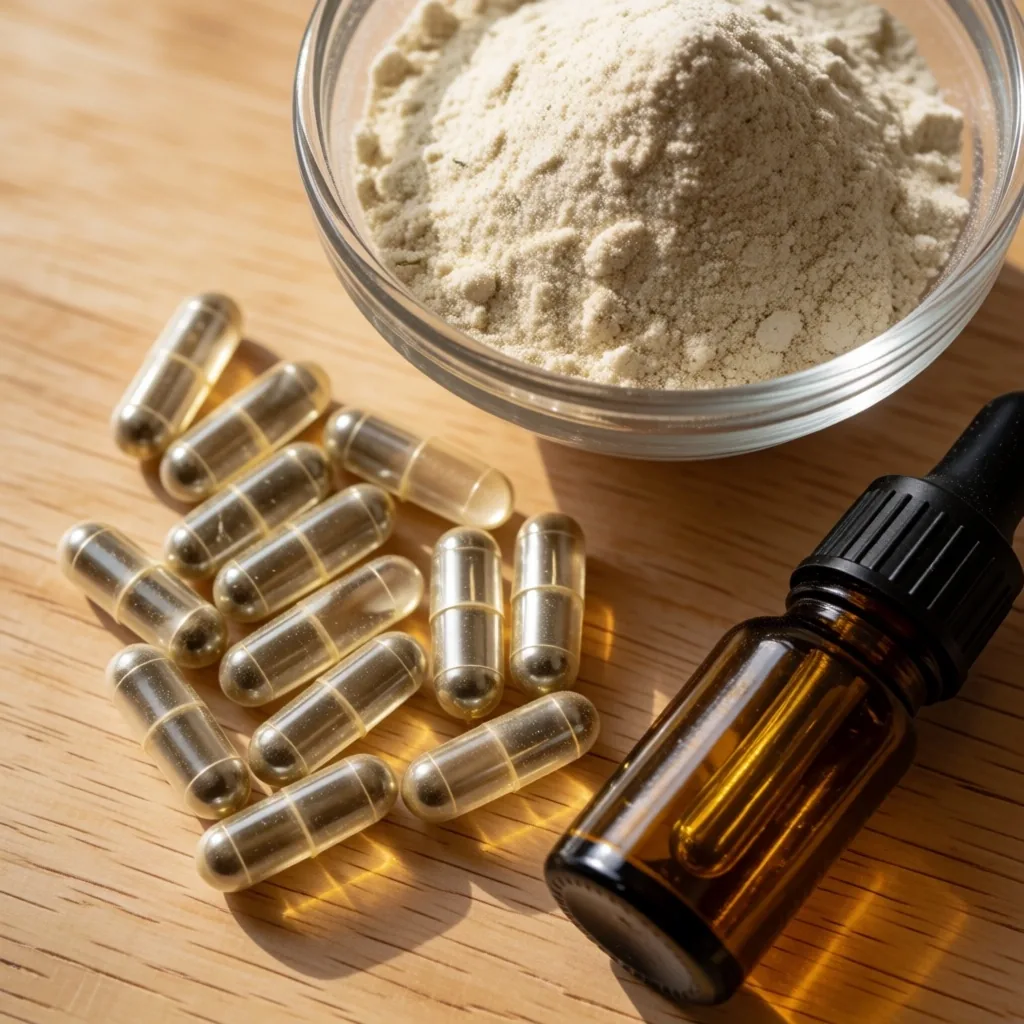
The delivery format of a supplement affects both its convenience and how quickly your body can utilize the nutrients. Capsules are easy to transport, while powders often allow for higher dosages of certain minerals. We compare the pros and cons of each format to help you decide which fits your lifestyle in Jakarta.
Portable, pre-measured, and easy to take with water. Capsules mask strong herbal tastes and travel well. Downside: limited to what fits inside a shell, typically under one gram per serving.
Allow larger serving sizes and flexible dosing. Mix into water or a smoothie. Ideal for minerals like magnesium that need higher amounts. Downside: taste, mixing, and carrying a container.
Fastest uptake since the body does not need to break down a capsule or dissolve powder. Useful for herbal tinctures and extracts. Downside: shorter shelf life after opening and taste can be intense.
Comparing Herbal Potency
Not all herbal extracts are the same strength. A 500 mg dose of a raw herb is very different from a 500 mg dose of a 10:1 concentrated extract. Our comparison tools help you calculate the actual potency of herbal products, allowing for a fair side-by-side evaluation of their effectiveness.
A 10:1 extract means ten parts of the raw herb were processed down to one part of finished extract. So 500 mg of a 10:1 extract delivers roughly the same active compounds as 5,000 mg of the raw herb. Without this math, two labels that both say 500 mg can represent a tenfold difference in what your body receives.
- Raw herb, 500 mg
- 1x baseline
- 4:1 extract, 500 mg
- ~2,000 mg raw equivalent
- 10:1 extract, 500 mg
- ~5,000 mg raw equivalent
- 20:1 extract, 500 mg
- ~10,000 mg raw equivalent
These figures illustrate the ratio math. Actual active compound levels depend on the herb, the extraction method, and the standardization marker used.
Cost vs. Value Analysis
A lower price point does not always mean a better deal if the ingredient concentration is low or the quality is poor. We help you look at the cost per serving and the quality of the raw materials. Divide the total price by the number of servings to get a real comparison between products of different sizes.
A cheaper product may use less of the active compound per serving. Two bottles at the same price can deliver very different value if one contains a 10:1 extract and the other uses raw herb powder. Always compare the active amount per serving, not just the total weight of the blend.
This approach ensures that your investment in your health is both economical and effective over the long term. A slightly more expensive product with transparent dosing and verified raw materials often costs less per month of actual use than a cheaper alternative you abandon because it does not deliver.
Bioavailability and Absorption

Certain forms of vitamins are easier for the body to absorb than others. For example, magnesium citrate is generally better absorbed than magnesium oxide. We highlight these differences in our comparison charts, so you can choose products that your body can actually put to use.
Purity and Third-Party Testing
When comparing brands, the presence of third-party testing is a major differentiator. We prioritize products that undergo independent verification for purity and active content. This section explains what to look for in terms of quality seals and lab reports to ensure your safety.
Independent testing means a laboratory outside the brand has checked the finished product for contaminants and confirmed that what is on the label matches what is in the container. Look for a certificate of analysis, often called a CoA, and check whether it covers the specific batch you are buying. A brand that publishes batch results openly is giving you the tools to verify the product yourself.
Be cautious when a brand only shows a logo without a searchable batch number or a link to the actual lab document. A seal alone does not tell you what was tested or when. The strongest signal is a dated report tied to the lot number on your bottle.
- Batch-specific CoA — a document tied to the lot number on your container, not a generic lab summary.
- Heavy metal screening — results for lead, arsenic, mercury, and cadmium, especially relevant for botanical extracts sourced from varied soils.
- Microbial testing — confirmation that the product is free from harmful bacteria and mold.
- Active compound verification — the lab confirms the listed ingredient amount matches the actual content.
Synthetic vs. Natural Sources
Some vitamins are synthesized in a lab. These forms are typically identical at the molecular level to their naturally occurring counterparts and are often more cost-effective to produce. A lab-synthesized vitamin C, for instance, is chemically the same as the vitamin C found in fruit. The advantage is consistency and affordability.
Others are derived from whole-food sources. While both can be effective, many men prefer natural sources for better synergy with other nutrients that come along naturally in the plant. A whole-food extract may carry trace co-factors that support how the body uses the main compound. We compare these two approaches to help you decide which aligns better with your wellness philosophy.
Tailoring to Your Specific Goals
A supplement that is right for a marathon runner might not be the best choice for a busy office executive. Our comparison matrix allows you to filter products based on your specific needs, whether that is daily energy, physical recovery, or general health maintenance.
Supporting an Active Workday
For long Jakarta commutes and back-to-back meetings, B-complex vitamins and adaptogenic herbs like ginseng are common starting points. Look for sustained-release formulas that avoid the quick spike and drop of single-dose caffeine-style energy.
After Training and Exercise
For regular gym sessions or weekend sport, zinc, magnesium, and branched-chain amino acids support muscle recovery. Compare mineral forms carefully — citrate and glycinate forms are generally well absorbed and suited for evening use.
Everyday Foundation
For overall wellness without a specific training goal, a balanced multivitamin with transparent dosing and a green-food or botanical blend can cover common gaps. Focus on consistency and label clarity over high single-dose numbers.
Frequently Asked Questions
How do I compare two supplements that use different measurement units?
+
Convert everything to milligrams per serving before comparing. If one label lists an ingredient in micrograms, divide by 1,000 to get milligrams. If another uses international units for a fat-soluble vitamin, check the conversion factor for that specific vitamin. Once both are in the same unit, compare the active amount per serving, not the total blend weight.
What is the difference between a standardized extract and a whole-herb powder?
+
A whole-herb powder is simply the dried plant ground into a fine powder. A standardized extract is processed to deliver a guaranteed percentage of one specific active compound. For example, a ginseng extract standardized to 5 percent ginsenosides guarantees that marker in every batch. Standardized extracts offer more consistency, while whole-herb powders may carry a broader range of naturally occurring co-compounds.
Should I always choose the product with the highest milligram number?
+
Not necessarily. More is not always better. Some vitamins have upper intake limits, and exceeding them does not provide additional benefit. A well-formulated product delivers an amount that is meaningful and absorbable, not just a large number for the label. Compare based on the form of the ingredient, the extract ratio, and how the amount relates to established daily values.
How do I know if a supplement brand is trustworthy?
+
Look for three things: transparent labeling with individual ingredient amounts, published third-party lab results tied to batch numbers, and clear contact information for the company. A brand that is open about where its ingredients come from and how its products are tested is easier to evaluate than one that relies on marketing language alone.
Ready to put these comparison tools to work?
Browse our ingredient guides for a deeper look at individual vitamins and botanical extracts, or read brand reviews to see how specific products hold up under the criteria outlined above.
Jl. Melawai Raya No. 34, Kebayoran Baru, Jakarta Selatan, 12160
Mon–Fri: 09:00–18:00 WIB
Kebugaran Pria provides educational content on natural vitamins and herbal supplements. Products discussed are intended as dietary supplements and are not a substitute for professional advice. Consult a qualified professional before starting any supplement routine.